
Lao to Vietnamese Translation for Work and Study: How to Follow a Conversation or Meeting With Lao Speakers
Published on Nov 23, 2026
Table of Contents
Key Takeaways
- Lao and Vietnamese are unrelated languages with different scripts, so word-for-word guessing does not work. You need translation, not “close enough” intuition.
- Lao is written in its own script (Unicode block U+0E80 to U+0EFF) and traditionally has no spaces between words, which makes machine processing harder than for Vietnamese.
- Both languages are tonal, but the tone systems differ, so a name or a number heard once can easily be misunderstood.
- For meetings and classes, the safest workflow is: agree the vocabulary first, use live captions during the session, and keep a transcript to check afterwards.
- Always confirm in your tool’s language list that Lao is available before you rely on it for an important conversation.
Why is Lao to Vietnamese translation harder than it looks?
Laos and Vietnam share a long border and a close political relationship. According to the overview of Laos–Vietnam relations on Wikipedia, the two countries established diplomatic relations in 1962 and signed a treaty of friendship in 1977, and Vietnam has been one of the largest foreign investors in Laos. That closeness means a lot of real work and study contact: factory managers, engineers, hospital staff, university students and trade partners talk to each other every day.
Closeness in politics does not mean closeness in language. Lao belongs to the Tai family and is described in the Lao language article as highly mutually intelligible with Thai. Vietnamese is a separate language with a different history and Latin-based script. A Vietnamese speaker cannot guess a Lao sentence the way a Spanish speaker can often guess Portuguese, so people rely on interpreters, bilingual colleagues or software.
What makes the pair difficult: script, tones and word boundaries
Three features explain most of the trouble.
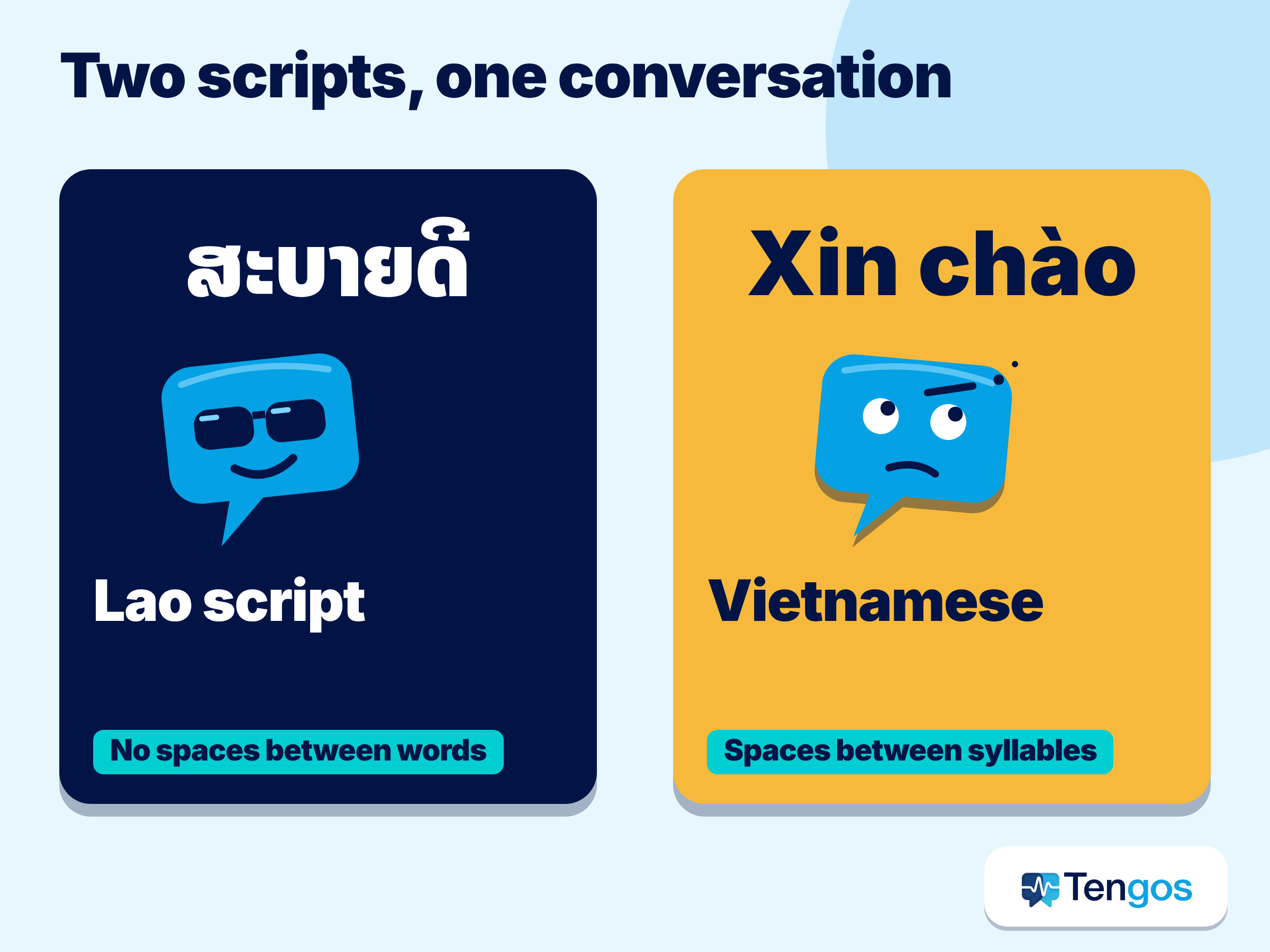
Script. Lao is an abugida written left to right in its own script, listed in the Unicode range U+0E80 to U+0EFF (see the Unicode Lao chart). Vietnamese uses the Latin alphabet with many diacritics. There is no letter-by-letter shortcut between them.
Word boundaries. As the Lao script article explains, Lao is traditionally written without spaces between words; a space works more like a comma or full stop. Software must first decide where words begin and end, and mistakes at this step travel into the translation.
Tones. Ethnologue lists Lao as a tonal language with six tones. Vietnamese is tonal too, but its tone system and marks are different. A syllable that sounds right to a Vietnamese ear may carry a different meaning in Lao.
| Feature | Lao | Vietnamese |
|---|---|---|
| Script | Lao script (abugida) | Latin alphabet with diacritics |
| Spaces between words | Traditionally none; spaces mark phrases | Spaces between syllables |
| Tones | Tonal (six tones per Ethnologue) | Tonal, different system |
| Word order | Subject, verb, object | Subject, verb, object |
| Closest well-known relative | Thai | None among Tai languages |
Where do people need Lao and Vietnamese translation in daily life?
Most cases fall into a few groups:
- Workplace meetings between Vietnamese and Lao teams, for example project check-ins, supplier calls or site visits.
- Classes and training, where a Lao student follows a lecture in Vietnamese or the reverse.
- Customer and service conversations in shops, clinics, logistics and tourism.
- Documents and messages such as contracts, safety instructions, forms and chat.
Each group has a different risk. A casual chat tolerates small errors; a safety briefing or a contract does not. Decide which category you are in before you choose how much to rely on software.
How should you prepare before a Lao and Vietnamese meeting?
Preparation removes most mistakes before they happen.

- Write a short glossary. List 10 to 20 terms the meeting will use (product names, machine parts, course terms) with the agreed Lao and Vietnamese version of each.
- Fix the names. Personal names are a classic problem. The W3C guidance on personal names reminds us that Vietnamese names follow family name, middle name, given name, and that people are often addressed by the given name. Ask each person how they want to be written and addressed, then keep that spelling everywhere.
- Check numbers and dates. Agree on the format for dates, currency and units, and repeat important numbers aloud.
- Test the audio. Use one speaker at a time, a decent microphone and a quiet room.
- Confirm the language is available in your tool before the day of the meeting.
What is a reliable workflow during the conversation?
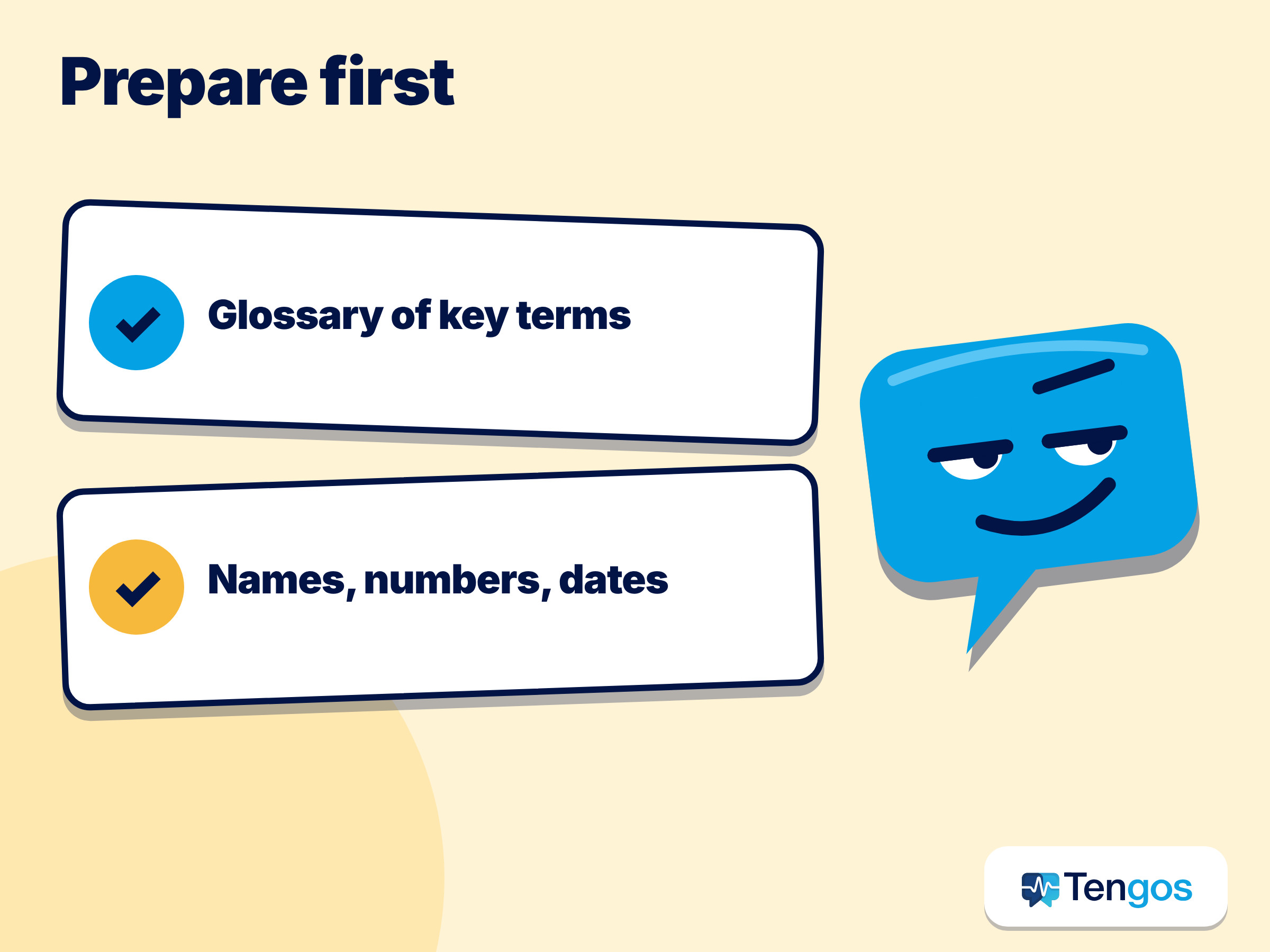
A simple three-layer workflow works for most teams:
| Layer | What it does | When it matters most |
|---|---|---|
| Live captions with translation | Shows what is said as text in your language while people speak | Fast discussion, unfamiliar accents |
| Short confirmations | One person restates decisions and numbers in both languages | Decisions, deadlines, amounts |
| Saved transcript | Lets you re-read and correct afterwards | Minutes, follow-up emails, study notes |
Tengos is built around this idea. According to its website, it offers real-time transcription, real-time streaming of a transcript through a shareable link, speaker identification, AI summary templates, and export in formats such as SRT, VTT, TXT and Markdown, and it advertises support for 60+ languages. The website does not list every language in the text we could read, so check the language selector in the app to confirm that Lao is offered for your account before an important session.
How can students use Lao and Vietnamese translation in class?
Students face a different problem from office teams: speed and volume. A lecturer speaks continuously, uses specialist words and rarely repeats.
- Record where allowed. Ask the teacher for permission and keep the audio file.
- Use live captions as a safety net, not as the only source. Follow the lecture and glance at the translation when a term is unclear.
- Review the transcript after class. Mark terms you did not know and add them to a personal glossary.
- Compare with the slides. Slides usually contain the correct spelling of technical terms; use them to correct the transcript.
- Ask for clarification in person when a point is critical for an exam.
What are common mistakes to avoid?
- Trusting a first machine translation for legal or safety content. Have a bilingual person review contracts, medical information and safety rules.
- Ignoring names and numbers. These are the items most often garbled and the most costly when wrong.
- Translating through a third language without noticing. Some tools route Lao to English and then to Vietnamese, which can add errors. Where possible, test the pair you need directly.
- Forgetting the script. Make sure your documents and software use UTF-8 so Lao characters and Vietnamese diacritics display correctly.
- Skipping a review. Even a quick re-read of the transcript catches many mistakes.
A short illustrative example (hypothetical)
Imagine a Vietnamese engineer and a Lao site supervisor reviewing a delivery schedule. This is an illustration, not a real case. The engineer shares a live transcript link, the supervisor speaks Lao, and captions appear in Vietnamese. When the supervisor mentions a delivery date, the engineer repeats it in Vietnamese and asks the supervisor to confirm. After the call, both read the saved transcript, correct one product name, and send a two-line summary. The tool did not replace judgment, but it reduced the number of things that could be misheard.
Frequently Asked Questions
Are Lao and Vietnamese similar languages?
No. Lao is a Tai language closely related to Thai, while Vietnamese belongs to a different family. They differ in script, vocabulary and tone system.
Can I use free translation tools for Lao to Vietnamese?
For casual messages, often yes. For contracts, medical or safety content, ask a bilingual person to review the result.
Does live translation work for Lao?
It depends on the tool. Language coverage differs by product and changes over time, so check the language list inside the tool before relying on it.
How can I keep names and technical terms consistent?
Prepare a short glossary in advance, agree on how each name is written, and review the transcript after the meeting to correct recurring errors.
Should students record lectures?
Only with the teacher’s permission and according to school rules. A recording plus a transcript makes review much easier.
Conclusion
Lao to Vietnamese communication is a growing need at work and at school, and it is genuinely hard because the languages differ in script, word boundaries and tones. The practical answer is a process: prepare a glossary, use live captions during the conversation, confirm key points aloud, and review a saved transcript afterwards. If you want to try that workflow, you can explore Tengos at tengos.ai and check the language list for your needs.
Sources
- Lao language, Wikipedia
- Lao script, Wikipedia
- Laos–Vietnam relations, Wikipedia
- Unicode chart for the Lao block
- Ethnologue: Lao
- W3C: Personal names around the world
- ISO 639:2023 language codes
Related reading: Live meeting translation