English for Meetings: 7 Ways to Keep Up When English Is Your Second Language
Publié le Oct 7, 2026
Table des matières
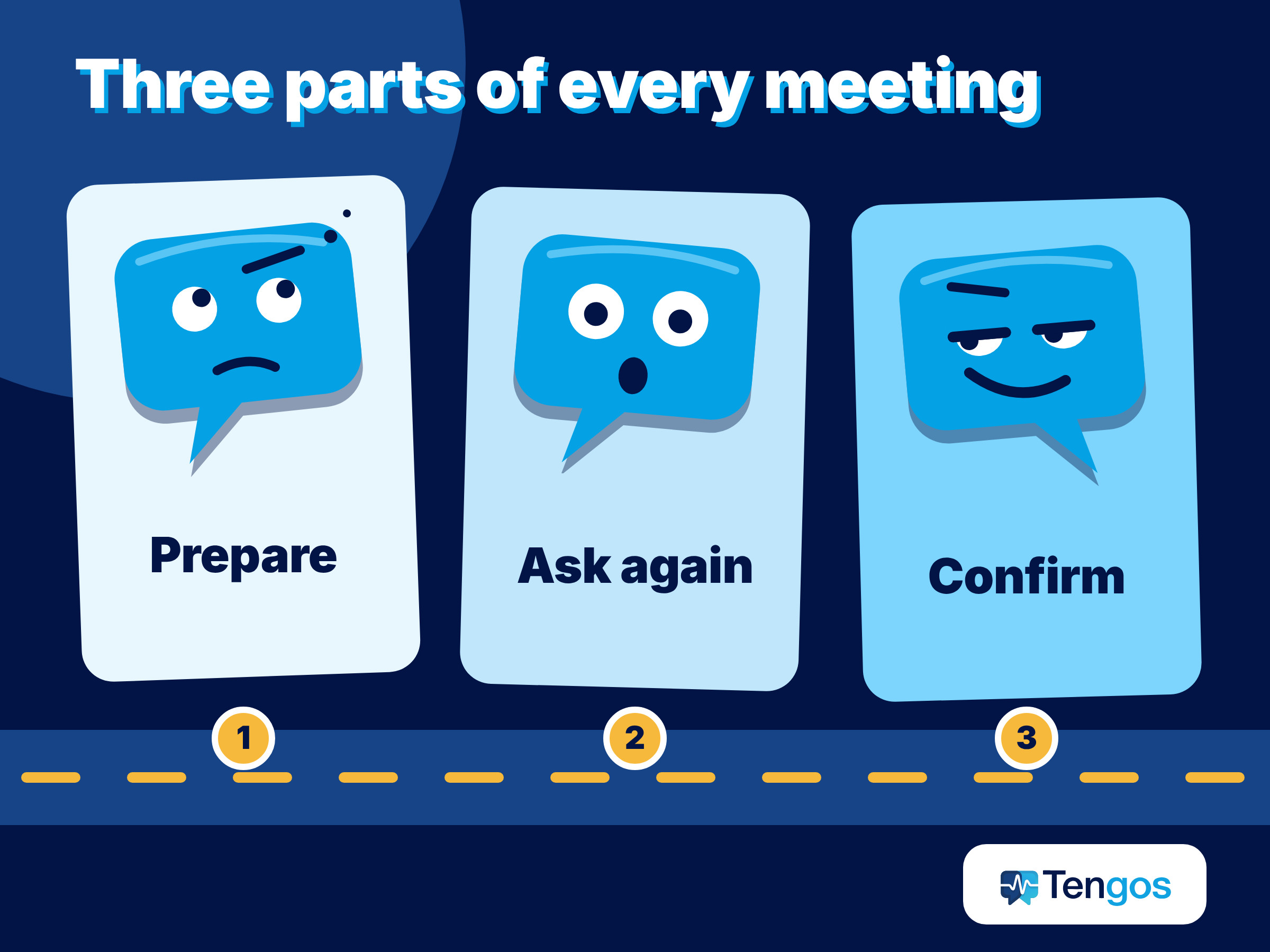
English for meetings gets a lot less tiring when you split it into three parts: 15 minutes of prep, a few well-timed questions during the call, and a written recap of every decision right after it ends. This guide is for professionals who read English comfortably but listen and speak more slowly. It covers practical habits, plus when it makes sense to bring in a real-time interpretation and note-taking tool.
Key Takeaways
- Reading English is not the same as keeping up with it live. In meetings, people talk fast, swallow sounds, bring different accents, and jump between topics.
- Most of the time you do not need every word. You need three things: what was decided, who does what, and by when.
- Short, regular practice with real recordings improves your English for meetings faster than one long weekly session.
- Asking someone to repeat or confirm, with one short and polite sentence, is the most useful skill to practice. It beats learning more vocabulary.
- Keep a record of the meeting (your notes or a transcript) so you can check it afterward, especially for decisions with deadlines.
- Support tools help you keep up in the moment, but they do not replace confirming important commitments yourself.
Why is English for meetings harder than reading English?
When you read, you can pause, look up a word, and read the line again. In a meeting, a sentence goes by once. You have to listen, understand, decide whether you need to answer, and sometimes take notes at the same time.
You are not the only one who feels this. An international survey of 883 translators and interpreters (conducted in 2022 and published in 2024 in Frontiers in Communication) found that, within each professional group, 49% to 86% of respondents estimated that at least half of the English speech they handle comes from non-native speakers. In other words, workplace English today is mostly English between people who use it as a second language, and even language professionals find unfamiliar word choices and unusual sentence structures hard to process (Albl-Mikasa et al., 2024).
A smaller study from Louisiana State University (posted on arXiv in 2025) surveyed 64 researchers who use English as a second language in multilingual meetings. Of those, 21 said they struggled to express their ideas clearly, 14 saw unfamiliar accents as a major obstacle, and many said it was very hard to listen and take notes at once (Gautam and Jasim, 2025). This is a small study of researchers, so treat it as a hint rather than a number that applies to every working professional. Still, the problems will sound familiar: explaining your point, understanding unfamiliar accents, and taking notes while you listen.
Before the meeting: 3 things to do in 15 minutes
Preparation is the cheapest way to improve your English for meetings.
1. Read the agenda and any documents first. If there is an agenda, read it and mark 5 to 10 industry terms that are likely to come up. Look up the meaning and say them out loud. Words you recognize on the page but have never heard spoken are the ones most likely to make you lose your place.
2. Decide what you need to walk out with. Write one sentence on paper: “Today I need to find out…” (for example, the project deadline, or who approves the budget). With a goal in mind, your brain filters better instead of trying to catch every word.
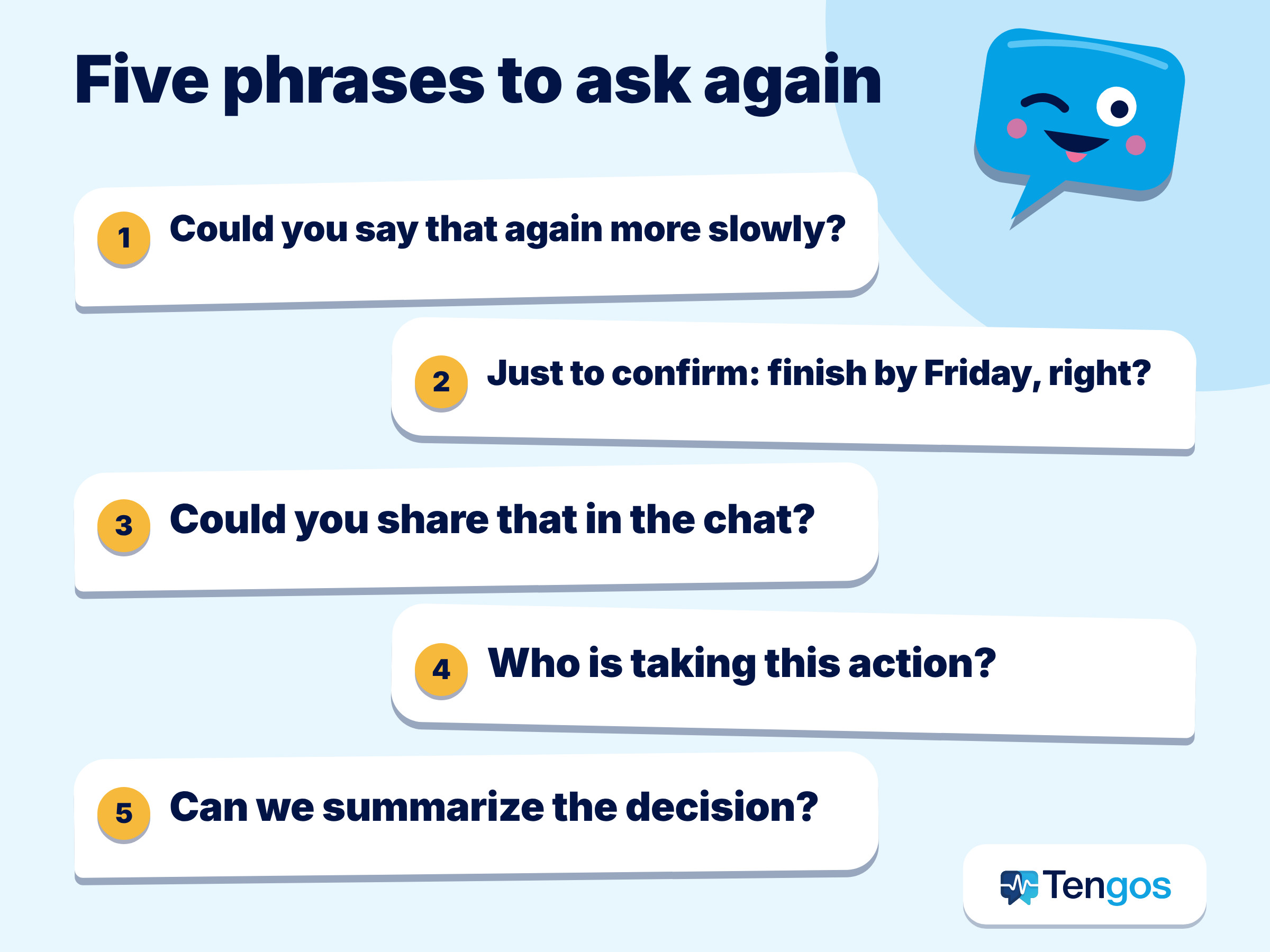
3. Keep a few “say it again” phrases ready. Memorize these five. They work in almost any meeting:
- “Sorry, could you say that again a bit more slowly?”
- “Just to confirm, you mean we need to finish this by Friday, right?”
- “Could you share that in the chat?”
- “Who is taking this action?”
- “Can we summarize the decision before we move on?”
During the meeting: 4 ways to keep up
In the call itself, English for meetings is mostly about staying calm and asking early.
4. Write keywords, not full sentences. Note names, numbers, dates, and action verbs (“send,” “approve,” “finalize”). A 30-minute meeting only needs one short page of notes.
5. Ask as soon as you lose the thread. Do not wait. Many people are afraid to interrupt, stay quiet, and then lose the rest of the discussion. Asking early almost always costs less than misunderstanding a decision. If interrupting feels awkward, type your question in the chat.
6. Confirm every commitment that has a deadline. At the end of each topic, say it back in one sentence: “So we agree Anna sends the quote by Wednesday, and I will review the contract, right?” That one line lets everyone fix any misunderstanding on the spot.
7. Use a support tool when the meeting is important or moving too fast. You can turn on the meeting platform’s automatic captions, record the call to replay it, or use a real-time interpretation and summary tool. The next section compares the options.
How do the different ways of supporting English meetings compare?
| Approach | Helps you understand during the meeting | Gives you a record to review | Best when |
|---|---|---|---|
| Prepare and take notes by hand | Partly, depending on your listening level | Only your own notes | Short meetings on familiar topics |
| Automatic captions from the meeting platform | Yes, but in English only | Usually not saved | You read English faster than you listen |
| Record and listen again later | No | Yes, but you replay the whole thing | You need to check one specific part |
| A tool with real-time interpretation and summaries | Yes, with a translation into your own language | Yes, with a summary and action items | Long meetings with many people and many decisions |
No single approach is perfect for every meeting. If you want to know more about how live translation works in meetings, you can read our article on live meeting translation. For a quick daily stand-up, preparation and good questions may be enough. For a meeting with big decisions, it helps to add one more layer of support.
After the meeting: put the decision in writing
The last part of English for meetings happens after the call ends.
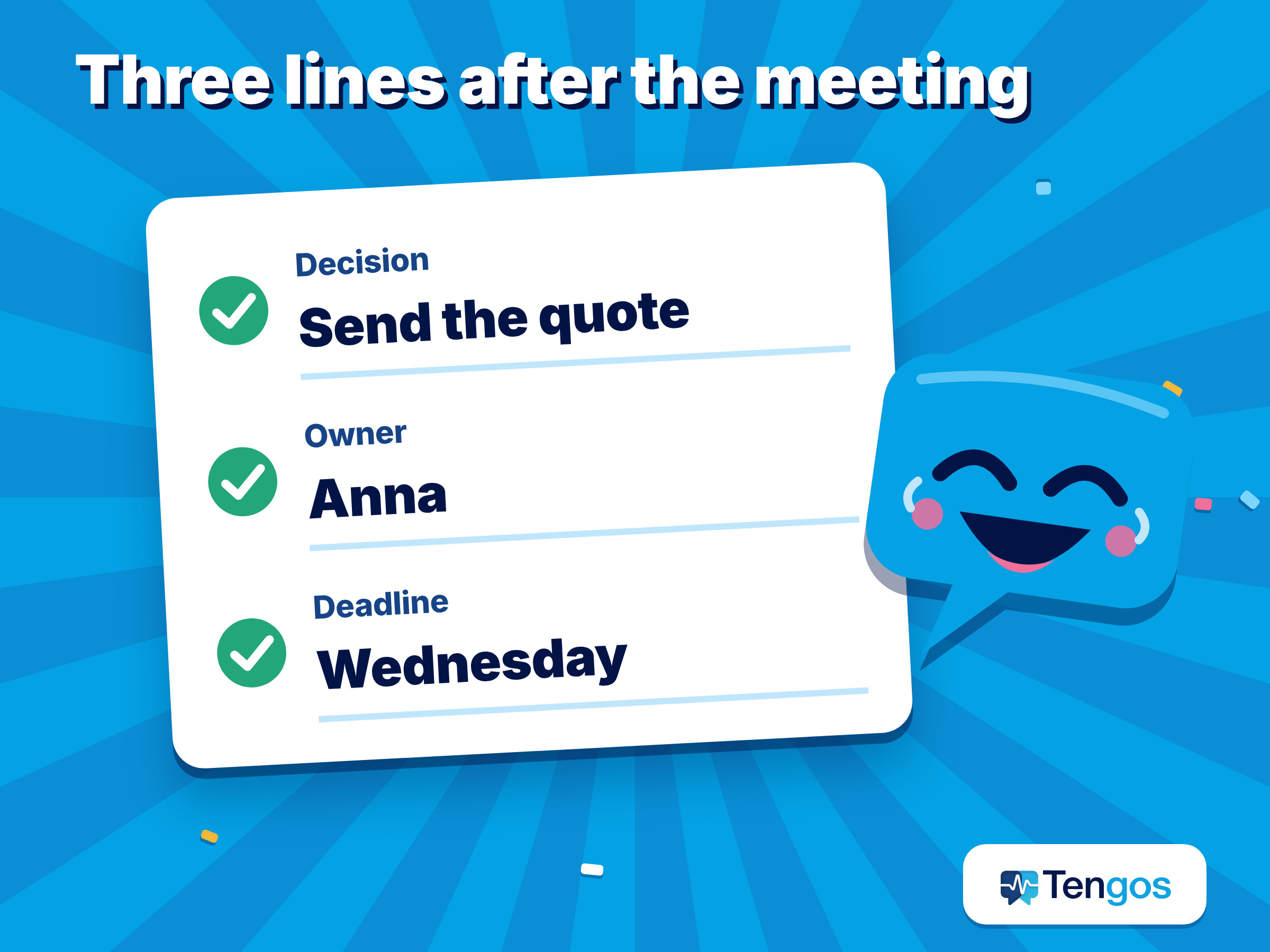
However much you understood, spend 5 minutes right after the call writing three lines: the decision, the owner, and the deadline. Send it to the people involved with a sentence like: “Here is my summary of what we agreed. Please correct me if I missed anything.”
This has two benefits. You have a written record if a misunderstanding comes up later, and native-speaking colleagues are usually glad to correct a short summary. That is much easier for them than re-explaining the whole meeting.
How can Tengos help with English meetings?
If English for meetings still feels tiring even though you can work in English, this is where a tool earns its place. Tengos is a meeting app with real-time interpretation across 60 languages and an AI Meeting Summary. You listen to the English and read a translation in your own language side by side. After the meeting, you get a summary with the decisions and action items to compare against your own notes.
The Free plan includes 120 minutes per month, no credit card required (see the pricing page). That is enough to try it in a few real meetings before deciding whether to keep using it. You can install the app for iOS on the App Store or Android on Google Play.
One caution: for meetings with major legal or financial consequences, still confirm in writing with the other party, or use a professional interpreter if your contract requires one.
Frequently Asked Questions
What should I do right away if I cannot keep up in an English meeting?
Ask for a repeat with one short sentence, such as “Could you say that again more slowly?” or type it in the chat. Asking early is always better than staying silent and misunderstanding everything that follows.
Should I ask to record the meeting?
Yes, if the meeting has decisions you will need to follow up on. Ask the organizer for permission before recording, and check your company’s policy on storing recordings.
How can I practice listening to English for meetings?
Listen to real meeting recordings or work-related podcasts at normal speed, then listen again with captions. Ten to 15 minutes every day works better than one long session each week.
Can a real-time interpretation tool replace learning English?
No, and it does not need to. A tool helps you keep up with today’s meeting, while practicing your English for meetings builds confidence over the long run. The two support each other.
When should I ask a native-speaking colleague or the meeting organizer for help?
When you often miss things in important meetings. A simple request like “Could you send me the notes after the meeting?” is usually granted right away.
Sources
- Albl-Mikasa, M., Ehrensberger-Dow, M., Gieshoff, A. C., Hunziker Heeb, A. (2024). Frontiers in Communication. A study of how language professionals process English from non-native speakers.
- Gautam, S., Jasim, M. (2025). LINC: Supporting Language Independent Communication and Comprehension in Multilingual Collaborative Meetings, arXiv.
- Tengos product information: pricing page.