Medical Translation App: Follow Doctor, School and Bank Talks Abroad
Published on Nov 13, 2026
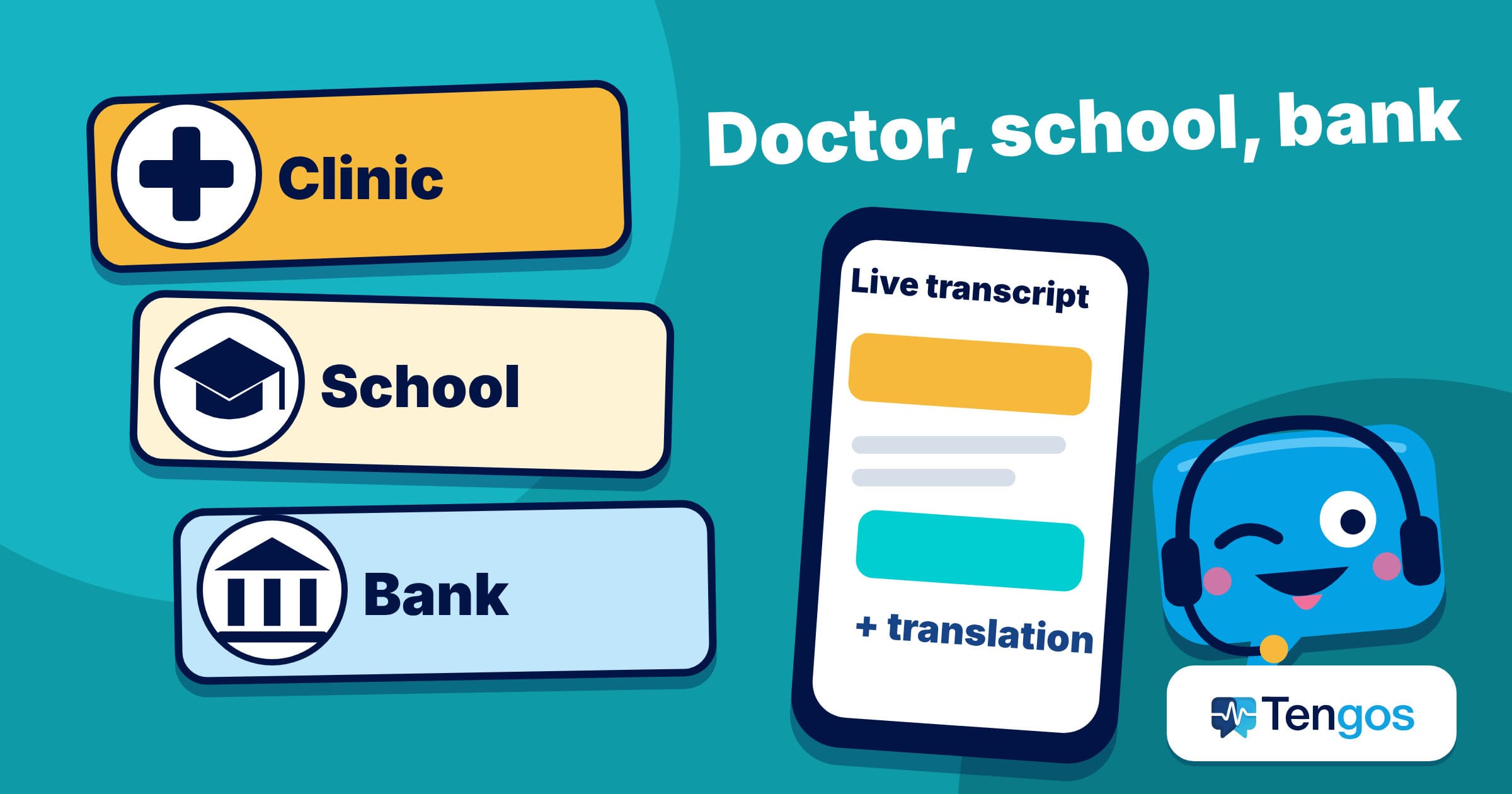
Table of Contents
A medical translation app can make a doctor’s visit less stressful when you live abroad, but it is not the right tool for every moment. This guide covers three conversations that matter most for families and expats, the clinic, the parent-teacher meeting and the bank, and shows how to prepare, when to ask for a professional interpreter, and where a live transcript with translation can help.
Key Takeaways
- A medical translation app is useful for following a conversation, taking notes and preparing questions, but studies of machine translation in health care show real error rates, so it should not replace a qualified interpreter for serious decisions.
- UK government guidance says automated services such as Google Translate should be avoided in healthcare settings, and a 2024 US HHS letter says qualified interpreters need demonstrated competence and that minors should not interpret except briefly in an emergency.
- School meetings and bank appointments usually carry lower clinical risk, so a live transcript with translation is often a practical way to follow along, as long as you ask for written copies of anything you sign.
- Prepare before you go: write your questions, learn the key terms, ask whether the place provides an interpreter, and test your app for two minutes.
- Tengos offers real-time speech transcription and real-time text translation in 60 languages, with a Free plan of 120 minutes per month, so you can try it before a real appointment.
Why do people reach for a medical translation app abroad?
Moving countries means constantly having conversations in a language you are still learning. Most of them are low stakes. A few are not: an appointment where a doctor explains a diagnosis, a meeting where a teacher describes your child’s progress, a bank counter where someone talks you through a loan or a fee.
In those moments you hear fast speech, unfamiliar vocabulary and polite shortcuts that dictionaries do not cover. You nod, you smile, and you leave unsure what was agreed. A phone that can show a live transcript and a translation in your own language feels like a lifeline, and in many cases it genuinely helps. The goal of this guide is to help you use it well, and to know where it stops being enough.
What is at stake in each of the three conversations?
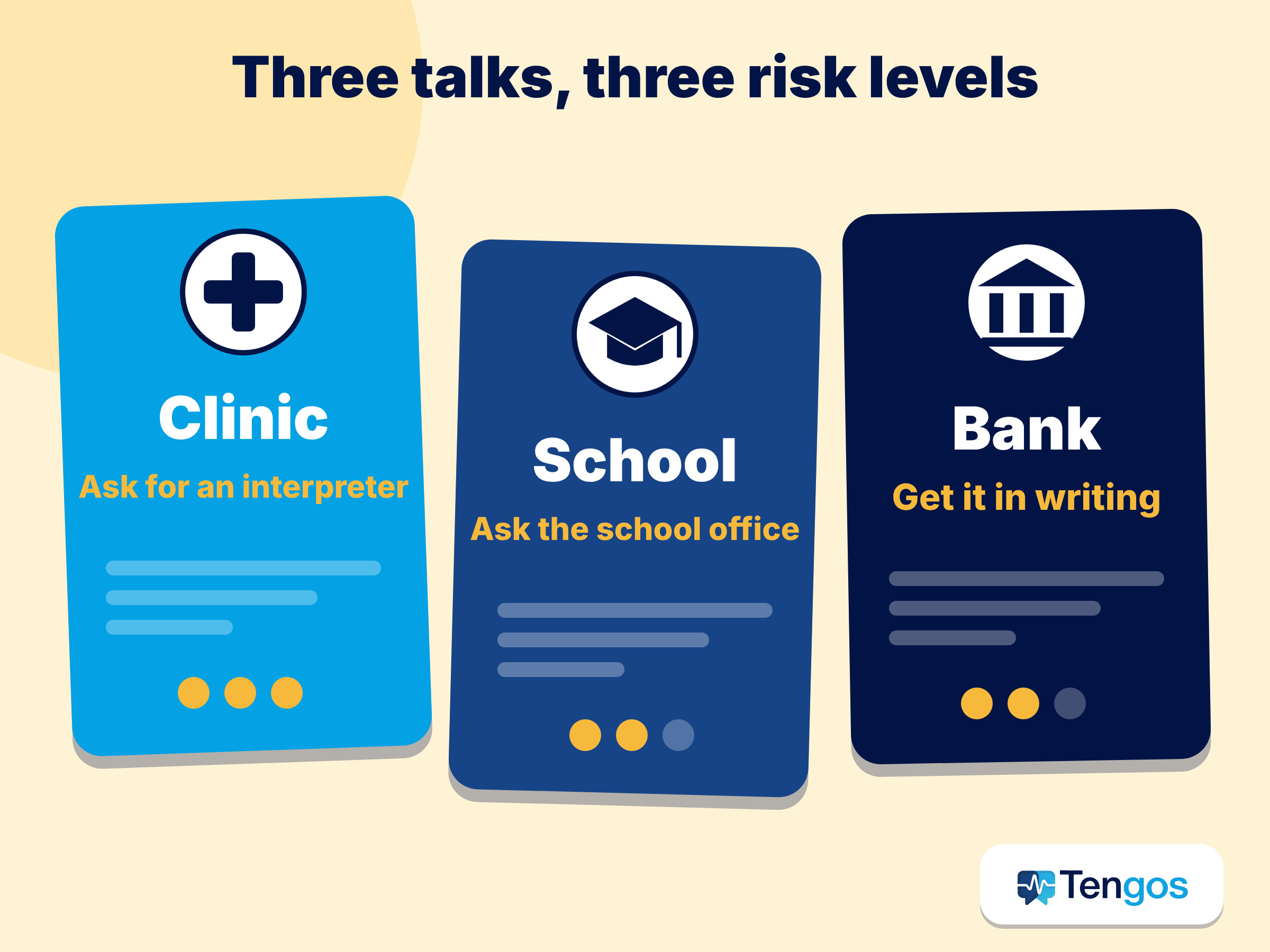
Not all conversations carry the same risk, so they should not get the same tool. The table below is a practical way to think about it. It reflects the guidance and research discussed later in this article, and it is not legal or medical advice.
| Setting | Typical stakes | Safest default | Where a live translation app helps |
|---|---|---|---|
| Clinic or hospital | Diagnosis, medication, consent | Qualified interpreter | Notes, preparing questions, checking what you heard afterwards |
| Parent-teacher meeting | Learning support, behaviour, next steps | Ask the school about interpretation | Following the discussion and writing down actions |
| Bank or financial service | Fees, contracts, loan terms | Written documents plus a person you trust | Understanding the conversation before you sign |
What does research say about translation apps in health care?
It is worth being honest about the evidence, because it is mixed.
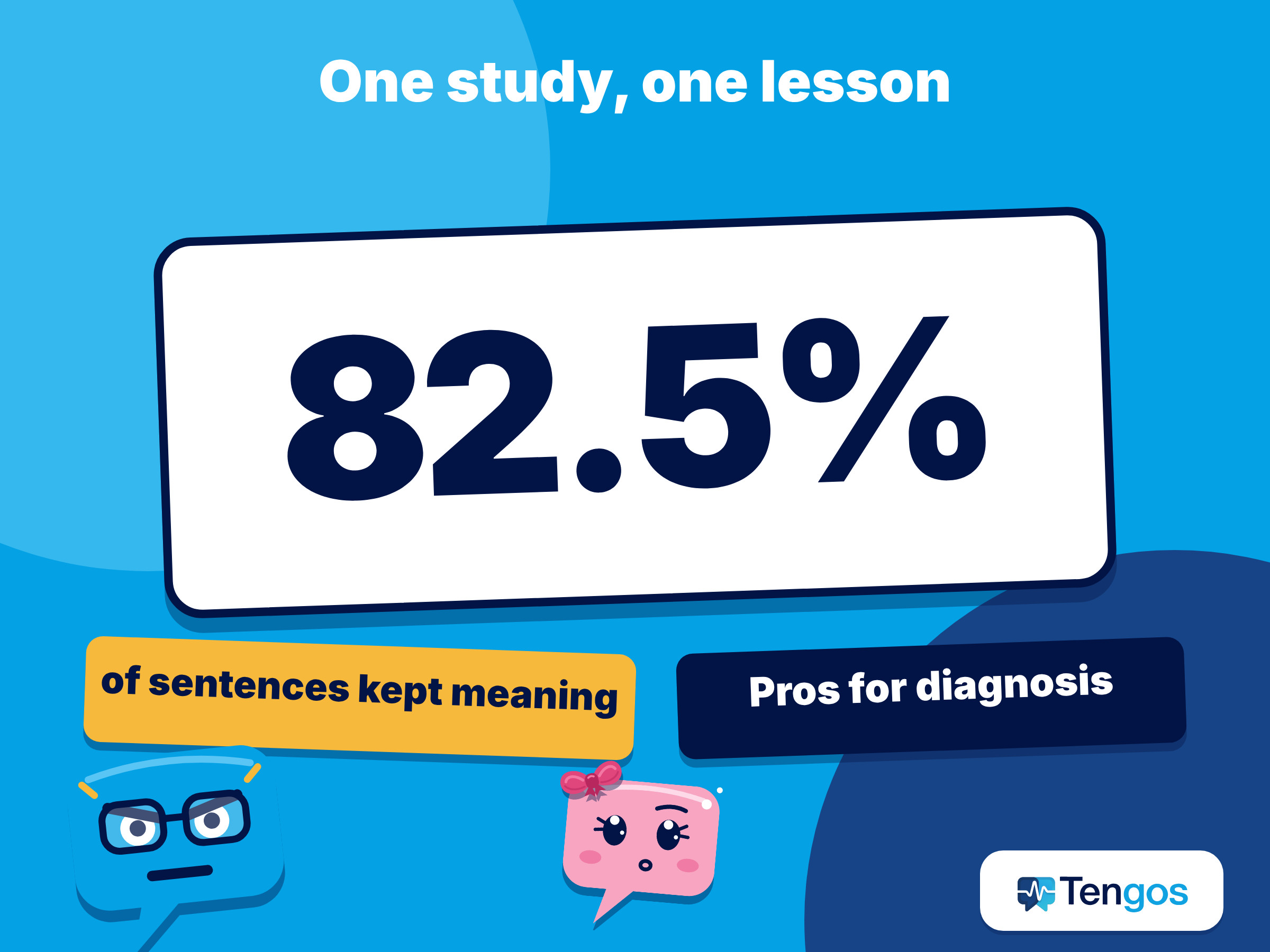
In a 2021 study in the Journal of General Internal Medicine, Taira and colleagues tested Google Translate on 400 emergency department instructions. According to the open-access version of the paper, 330 of the 400 sentences (82.5%) kept their meaning. Accuracy varied by language, from 94% for Spanish to 55% for Armenian, and the authors concluded the tool was not ready for use in the emergency department for patient-specific instructions, recommending professional translation and certified interpreters instead.
A 2019 JAMA Internal Medicine study by Khoong and colleagues looked at 100 real discharge instructions. As summarised by the AHRQ Patient Safety Network, the translations were accurate 92% of the time for Spanish and 81% for Chinese, and fewer than 10% of the inaccurate translations were potentially harmful.
On the more encouraging side, a systematic review in the Journal of Medical Internet Research of electronic tools for patients who have migrated found that translation apps showed better communication and shorter consultations, but only about half of the apps evaluated were effective, and the authors called for more rigorous evaluation.
The sensible reading is that machine translation can be good enough to help, and not reliable enough to bet your health on without a human check. Those studies also tested older general-purpose tools, so results for any particular app, language pair and accent will differ.
When should you ask for a professional interpreter instead?
For medical decisions, the official guidance is consistent. The UK Office for Health Improvement and Disparities migrant health guide recommends offering a professional interpreter rather than relying on relatives or friends, and says children should not interpret. It also states that automated online translating systems such as Google Translate should be avoided in healthcare settings.
In the United States, a December 2024 HHS Office for Civil Rights letter on Section 1557 language access explains that a qualified interpreter must have demonstrable competence, that being bilingual is not enough, that facilities cannot require patients to bring their own interpreter, and that minors should not interpret except temporarily in an emergency. It allows machine translation in an emergency as a stopgap, followed by review by a qualified person as soon as possible. US language-access rules have been changing since then, so ask the provider what they currently offer.
Why the fuss about quality? A classic study by Flores and colleagues in Pediatrics analysed 13 paediatric visits and found 396 interpretation errors, about 31 per visit, and 63% had potential clinical consequences. Ad hoc interpreters, such as a nurse or an 11-year-old child, made errors with potential consequences 77% of the time, against 53% for hospital interpreters. The point is not that interpreters never err. It is that conversations in health care are easy to get subtly wrong, and training matters.
Professional standards describe what you should expect. The National Standards of Practice for Interpreters in Health Care say an interpreter should convey the message completely and accurately, without adding, omitting or changing anything, and should keep what they hear confidential.
In short: for a diagnosis, a consent form, a new medication or a mental health discussion, ask for a qualified interpreter. Use an app for everything around it.
What do schools and banks have to provide?
This depends on where you live, and in some places the rules are in flux, so treat this section as a reason to ask rather than a statement of your rights.
In the United States, the Department of Education and Department of Justice issued a 2015 guidance letter saying schools should offer free oral interpretation to parents with limited English proficiency when written translation is not feasible. The Education Department rescinded that letter in August 2025. A Congressional Research Service overview notes that an executive order from 2000 on language access was revoked in March 2025 and that Title VI requirements for federally funded programmes still exist but appear to be changing. Policies in other countries and in individual states or municipalities differ, so the practical step is simple: ask the school office in advance whether an interpreter can be provided.
For banks, the US Consumer Financial Protection Bureau published a 2021 statement on serving consumers with limited English proficiency, which estimated about 25.5 million people with limited English proficiency in the US and described the difficulties they face with financial products. It is archived guidance, not a rule, but it is a good reminder: ask for key documents in a language you can read, and never sign what you do not understand.
How can a live transcript with translation help in a conversation?
A live transcript turns speech into text as it happens, and live translation puts your language right beside it. That gives you something an audio-only translator does not: a written record you can scroll back to when a sentence goes by too fast.
Google’s own help page for live translate describes the basic pattern of conversation mode: open the app, choose the languages, and take turns speaking. That turn-taking works well for short exchanges. For longer conversations, such as a 30-minute parent-teacher meeting, many people prefer to read a running transcript and translation while the other person speaks naturally.
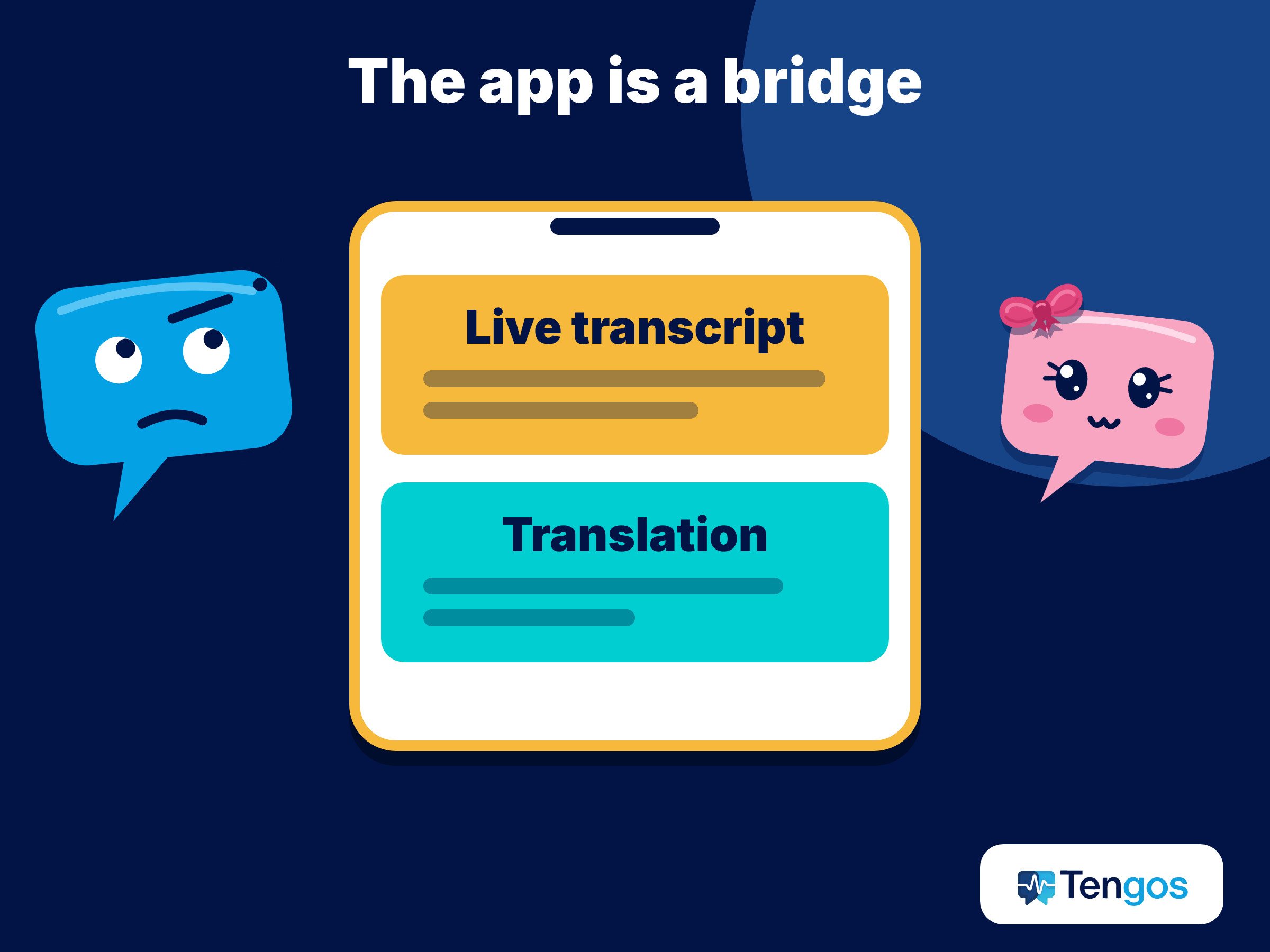
Tengos is an AI assistant for real-time speech transcription and translation. According to its pricing page, it offers real-time speech transcription and real-time text translation across 60 languages, speaker identification, transcript export and AI meeting summaries, with a Free plan of 120 minutes per month and up to 15 minutes per recording, plus paid plans with longer recordings. Its features page describes a live bilingual transcript, showing the original speech and its translation side by side. The app is available on iOS and Android.
Two practical notes. The Free plan’s 15-minute recording limit means a long meeting needs a new session partway through, so tell the other person you are doing that. And speech recognition is never perfect, so check names, numbers, dates and doses against what is written on paper.
How do you prepare before the appointment?
Preparation does more for you than any app. Here is a routine that takes about 20 minutes.
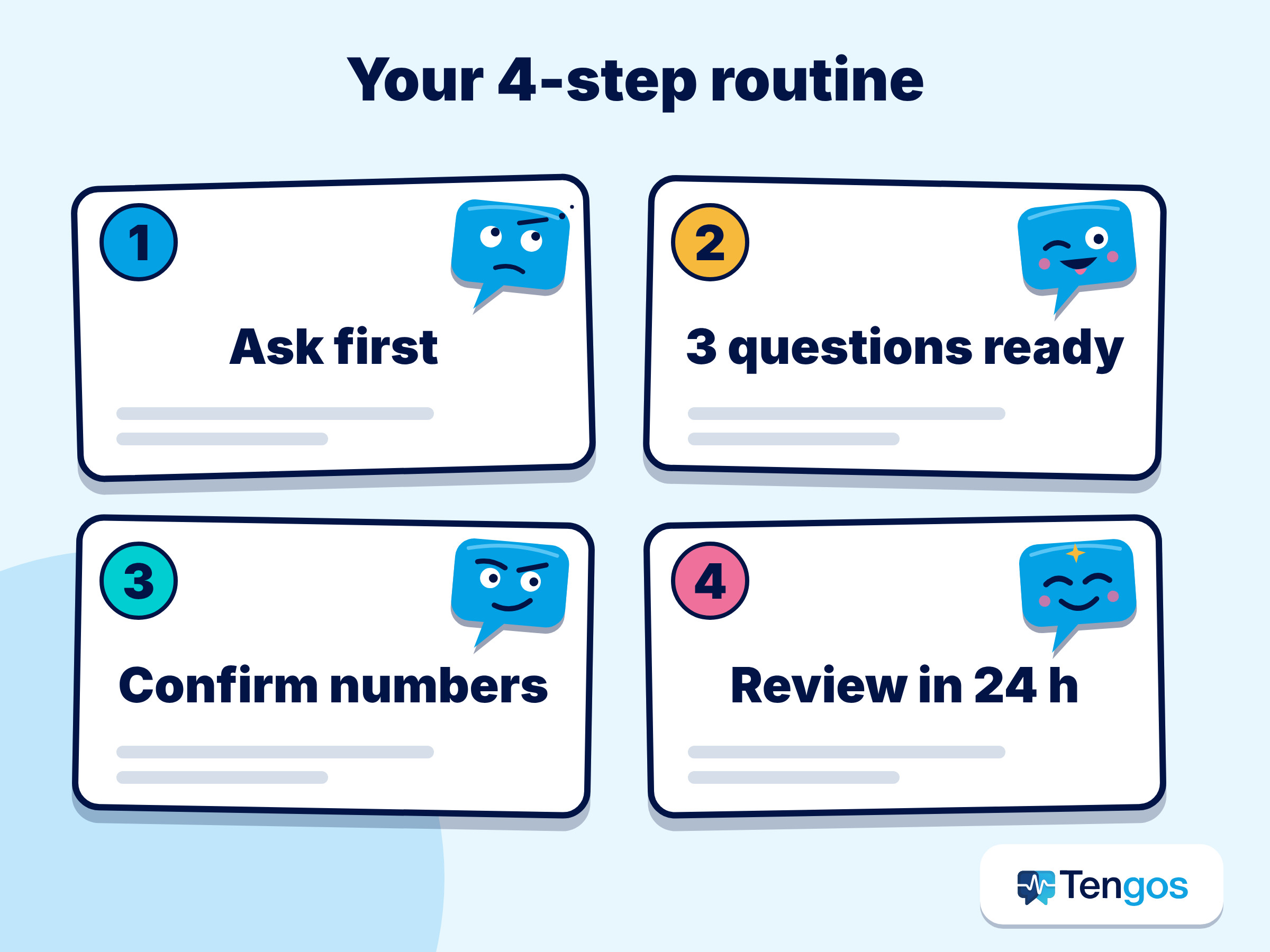
- Ask about interpretation first. When you book, ask whether a qualified interpreter is available, and whether it is free. For a medical visit, ask for one in your language.
- Write three questions in your own language. For a clinic: what is the diagnosis, what should I do, what should I watch for. For school: how is my child doing, what do you recommend, how can I help at home. For a bank: what are the total costs, what happens if I miss a payment, can I have this in writing.
- Learn the ten terms you will need. Look up the words for the situation, such as “prescription”, “allergy”, “report card”, “interest rate” or “fee”, and save them in a note. If your app supports custom terms, the Tengos pricing page lists 50 translation terms on the Starter plan and more on higher plans.
- Test your setup. Spend two minutes with a friend or a video, checking the microphone, the language pair and the screen brightness. Bring a charger.
- Ask permission. Tell the other person you will use an app to follow the conversation and take notes. Most people say yes, and it is the polite and often legally important thing to do, especially when you are recording.
What should you do during the conversation?
- Put the phone where both of you can see it. A shared screen turns the app into a bridge, not a secret.
- Speak in short sentences and pause. Machine translation handles one idea at a time better than a long run-on.
- Confirm numbers and names by writing them down. Ask the person to write a dose, a date or an amount on paper.
- Use the “teach back” habit. Say, in your own words, what you understood and ask whether it is right.
- Mark the moments you are not sure about. Tengos and similar tools keep a transcript, so you can review that part later or take it to a professional.
An illustrative example, not a real case: imagine a parent at a 20-minute parent-teacher meeting abroad. The teacher mentions that their child “needs support with reading comprehension” and suggests “a short assessment next term”. With the live transcript, the parent sees both phrases in their own language, asks what the assessment involves, and writes down the date. Without it, they might have nodded and gone home unsure whether the school had raised a concern or just made small talk.
What should you do after the conversation?
Review within 24 hours, while you still remember the context. Read the transcript and translation, highlight anything surprising, and write a three-line summary: what was decided, what you need to do, and what you still do not understand. If the conversation involved a medical decision, a prescription or a financial commitment, take your notes to a professional interpreter or a trusted bilingual advisor and ask them to confirm the key points. If you have recorded the conversation, store it carefully, because it may contain sensitive information.
Frequently Asked Questions
Can I use a medical translation app at the doctor?
It can help you follow along and prepare, but research found real error rates, and official UK guidance says automated translation services should be avoided in healthcare settings. For diagnoses, consent and medication, ask for a qualified interpreter and use the app as a supplement.
Can my child or a relative interpret for me?
Guidance from both the UK and the US advises against it for medical visits, particularly for children, and a study of paediatric visits found more potentially consequential errors with ad hoc interpreters than with professional ones.
Do schools have to provide an interpreter for parent-teacher meetings?
It depends on the country and, in some cases, the state or district. In the US, a 2015 federal guidance letter on this was rescinded in 2025, so ask the school directly instead of assuming.
Can I use Tengos at a bank or a school meeting?
Yes, you can use a live transcript and translation to follow the conversation, as long as you tell the other person and follow local rules about recording. Keep in mind that the Free plan allows up to 15 minutes per recording.
Is Tengos free to try?
Its pricing page lists a Free plan with 120 minutes per month. Check the page for the latest limits and plans.
Final thoughts
A medical translation app is best thought of as a bridge, not a replacement for human interpreters. Use a qualified interpreter when your health or legal rights are on the line, and use live transcripts and translation to prepare, follow the conversation, and keep a record for later. If you would like to try the live transcript side of that routine before your next appointment, you can explore Tengos at tengos.ai.
A medical translation app works best when you prepare first and verify what matters. Start with one short test today.