How AI Tools Improve Better Global Team Communication
2026. 5. 29. 게시됨
목차
Global team communication has always carried an invisible tax: the people best positioned to do the work don’t always share a language. Decisions get made without the right voices in the room. Knowledge gets captured in one language and becomes inaccessible to half the team. Alignment that should take a meeting takes three.
AI is changing that – not by eliminating language differences, but by removing the friction they create in global team communication. Here’s exactly how.
The Core Problem Blocking Global Team Communication
Before getting into the tools, it’s worth naming what the problem actually is.
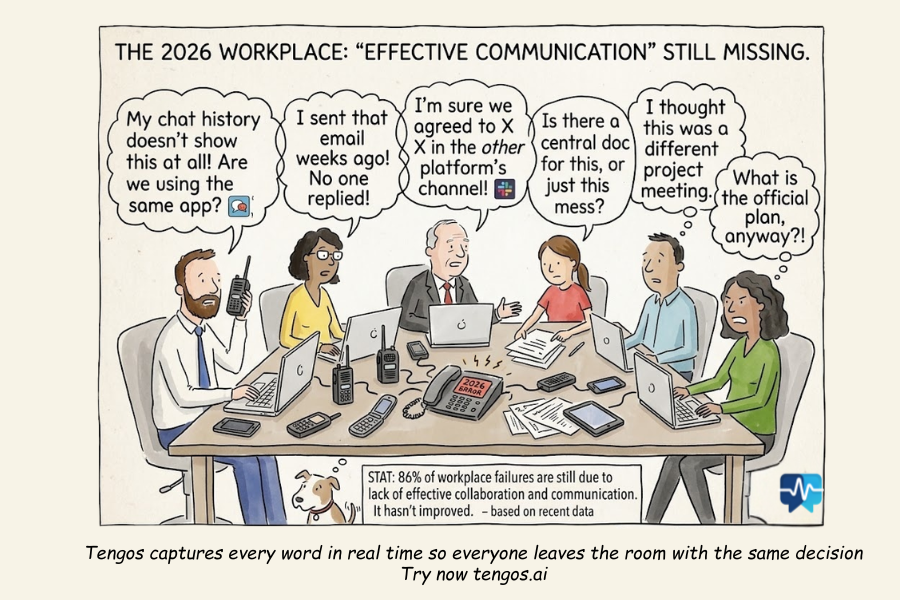
Language barriers in global team communication aren’t just translation problems. They’re participation problems. When a non-native speaker can’t follow a fast-moving conversation in real time, they don’t just miss words — they miss the context that shapes decisions. They contribute less. Their expertise goes underused. The team makes decisions that reflect who spoke confidently, not who knew most.
A research found that 68% of business leaders say language barriers reduce team productivity, and 49% of executives report direct financial losses from miscommunication. These aren’t soft metrics — they’re operational failures with measurable costs.
AI tools address global team communication at the root: by making real-time, multilingual communication as frictionless as communicating in your first language.
5 Ways AI Tools Improve Global Team Communication
Good global team communication requires more than a shared video call. It requires every participant — regardless of their native language — to receive, process, and contribute to the same conversation in real time. Here’s how AI makes that possible.
1. Real-Time Translation Keeps Everyone in the Conversation
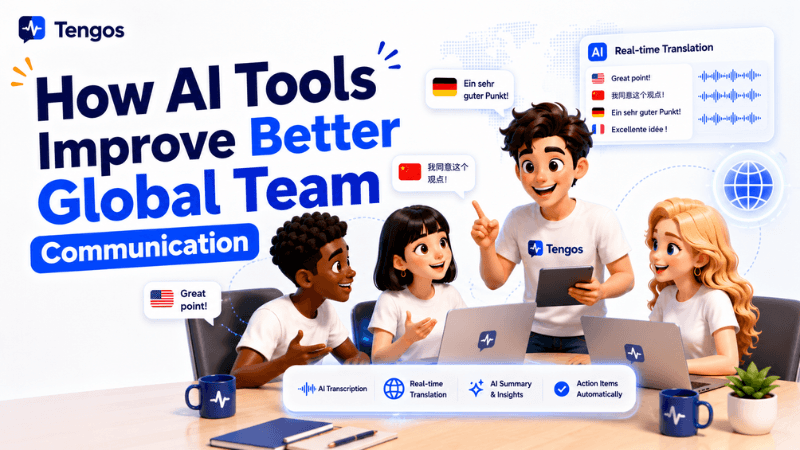
The most immediate improvement AI brings to global team communication is real-time translation — the ability to read or hear what’s being said in your own language, as it’s being said.
Traditional approaches to multilingual meetings involved human interpreters (expensive and hard to scale), pre-translated materials (static and slow), or an implicit “English-only” default that effectively excluded non-native speakers from full participation.
Based on a sample of 1,002 U.S. business decision-makers, the report shows that 63% of leaders rely on translation tools weekly, and 40% use them daily. These tools are often critical for handling internal communications, external partnerships, and cross-border documentation.
AI translation eliminates all three problems. Modern AI can handle 60–100+ languages simultaneously, with accuracy that handles technical and domain-specific vocabulary. The result: a meeting where a French-speaking team member and a Japanese-speaking team member can both participate in real time — without either waiting, without an interpreter, without a separate follow-up.
2. Automatic Transcription Creates a Shared Record for the Whole Team
One of the biggest gaps in global team communication is the record that comes after the meeting. Even when everyone speaks the same language, what people remember is imperfect. When multiple languages are involved, it becomes significantly worse — different people remember different things, filtered through different levels of comprehension.
AI transcription solves this by generating a complete, verbatim record of everything said in a meeting — in real time, across every speaker. Paired with translation, it means every participant has access to the same record, in their own language, the moment the meeting ends.
The practical effects are significant:
- No more “what was decided?” — the transcript captures every decision as it was stated, not as someone later remembered it
- No more selective notes — the record isn’t filtered through one person’s attention and comprehension
- No more language exclusion — the record exists in every team language, not just the meeting’s working language
For global teams, a complete multilingual transcript is the difference between a meeting that generates reliable knowledge and one that generates four different versions of what happened.
3. AI Summaries Turn Meetings Into Actionable Documents
Transcripts are valuable as a record but they’re not useful as a working document. A 60-minute meeting generates 6,000–10,000 words of transcript. No one reads it.
AI summarization solves this by extracting the signal from the noise: the decisions made, the commitments given, the action items assigned, and the key discussion points worth remembering. Delivered automatically, at the end of every meeting, in every relevant language.
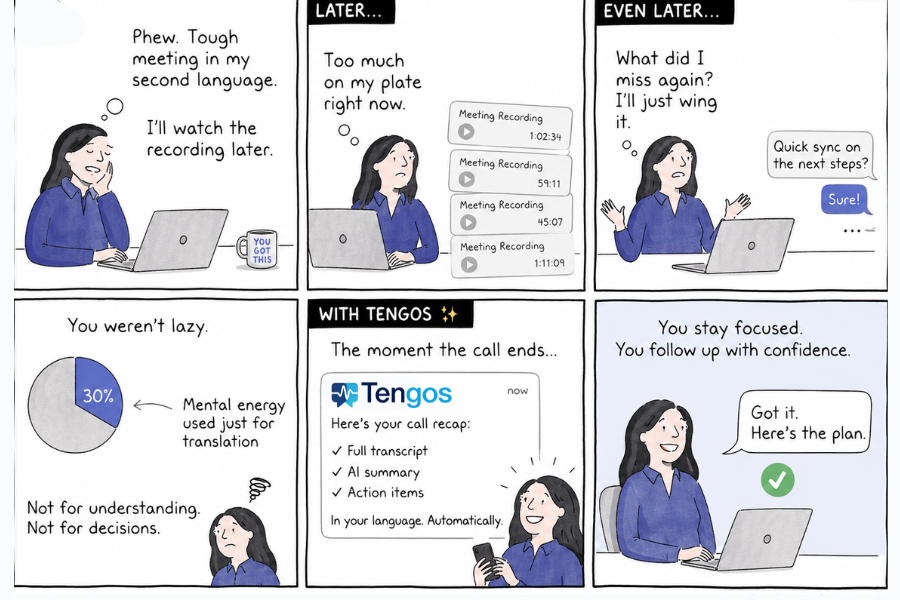
This matters for global team communication in a specific way: it means the people who weren’t in the room — the team members in a different timezone, the stakeholders who needed the outcome but not the discussion — get a structured, reliable, multilingual briefing instead of a wall of text or a game of telephone.
According to research by McKinsey, knowledge workers spend 14% of their working week communicating and collaborating to share information. AI summaries compress a significant chunk of that time by making meeting outputs instantly usable instead of requiring manual synthesis.
4. AI Reduces the Cognitive Load That Blocks Global Team Communication
This benefit is less obvious than real-time translation, but arguably more important for global team performance.
Working in a second language has a real cognitive cost. Research on linguistic processing shows that operating in a non-native language consumes significantly more mental energy than working in your first — leaving less capacity for the actual work of the meeting: listening critically, synthesizing information, contributing ideas.
AI communication tools reduce this load. When a non-native speaker knows that a real-time transcript is available in their language, they can focus on the substance of the conversation instead of allocating mental bandwidth to parsing fast speech, unfamiliar accents, or complex sentence structures.
For global teams trying to build high-performance cultures across languages, this is one of the highest-leverage improvements AI enables.
5. AI Builds a Searchable, Multilingual Knowledge Base
Every meeting is a knowledge event. Most organizations treat it as a temporary conversation. The best-performing global organizations treat it as a knowledge asset.
AI communication tools make this shift practical. When every meeting is automatically transcribed, translated, and summarized, the organization builds a searchable record of everything discussed, decided, and committed to — across every language the team operates in.
This has compounding value over time:
- New team members in Tokyo can search the record of a product decision made six months ago in Berlin and read it in Japanese
- A sales manager in US can pull every commitment made in client meetings over the past quarter, summarized in Portuguese
- A leadership team can review the key decisions from the last three months of cross-functional meetings without reconstructing them from memory or disparate notes
A multilingual, searchable knowledge base built from every meeting is a significant structural advantage — and AI makes it a default, not a project.
What to Look for in an AI Tool Built for Global Team Communication
Not all AI tools are built for the multilingual reality of global team communication. When evaluating options, the core requirements are:
- Language breadth: The tool should support the actual languages your team uses — not just major European languages, but the full range of your team’s languages. Look for tools that handle 60–100+ languages with domain-aware accuracy.
- Real-time capability: Translation and transcription that arrive after the meeting don’t solve the participation problem. Real-time is non-negotiable for live communication improvement.
- Structured output: Raw transcripts aren’t useful at scale. The tool should generate structured summaries — decisions, action items, key points — not just word-for-word logs.
- Zero-friction adoption: A tool that requires every participant to create an account, download an app, or manage complex setup will see low adoption. The best tools require nothing from participants — a shared link gets everyone in.
- Enterprise security: Meetings contain sensitive information. Any tool handling multilingual corporate communication should be SOC2 ready, GDPR compliant, and use end-to-end encryption. Confirm they don’t train models on your data.
The Shift Already Happening in Global Team Communication
AI has made that default accessible. Real-time translation, automatic transcription, structured summaries, and multilingual documentation are no longer enterprise-only capabilities. They’re available to any team that chooses to treat global team communication as a first-class operational priority.
For global teams, the question isn’t whether AI tools are worth adopting to improve global team communication. It’s how quickly the gap between teams that have adopted them and teams that haven’t will become competitively significant.
Tengos – Every Moment. Any Language. In Real Time.
Tengos gives global teams real-time translation and transcription across 100+ languages, AI meeting summaries with action items, and shareable documentation — with nothing required from participants except a link. Start free at tengos.ai