
Meeting Productivity: Why Teams Forget 70% Meeting Content?
2026. 5. 29. 게시됨
목차
You just spent an hour in a meeting. Important decisions were made, commitments were exchanged, action items were assigned.
Three days later, ask everyone what was decided. You’ll get different answers.
This is one of the most common meeting productivity failures in any organization — and it’s not a memory problem. It’s a documentation problem. Without a reliable meeting summary, the knowledge generated in that hour disappears. And the cost compounds silently across every team, every week.
The Forgetting Curve: The Root of Meeting Productivity Failures
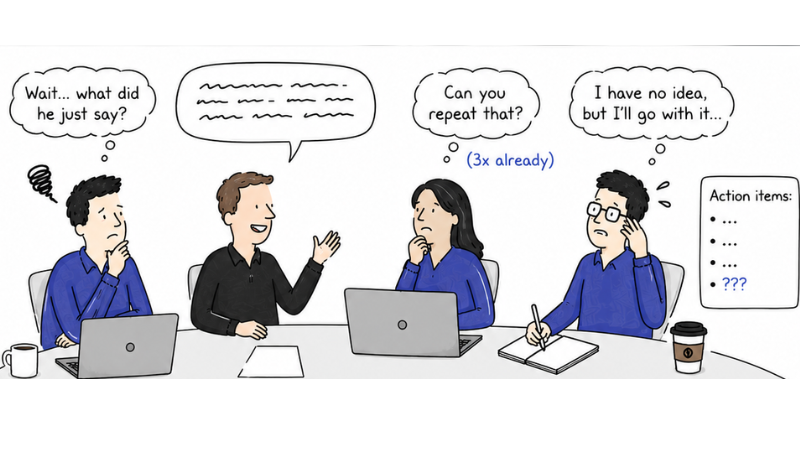
Meetings are one of the highest-stakes environments where the “forgetting curve” plays out because:
- A typical one-hour meeting generates dozens of micro-decisions, verbal commitments, and context-dependent agreements
- None of them have reinforcement structures — no meeting summary the team engaged with, no repetition, no retrieval practice
- The conversation ends and the calendar invite for the next meeting starts immediately
The result: meeting productivity collapses in the 24 hours after the call. Teams operate on different versions of the same conversation. The sales lead remembers the pricing decision one way. The product manager remembers a different timeline. The engineer who was “definitely going to handle that” doesn’t remember it being definitive at all.
Why Meeting Notes Don’t Fix Meeting Productivity
The standard response to this problem is meeting notes. They help but they don’t fix meeting productivity at the root. Here’s why.
1. Notes are one person’s perspective
Every set of meeting notes is a filtered record. The note-taker decides — consciously and unconsciously — what’s worth capturing.
- Nine other people’s understanding of what was important never makes it into the record
- The note-taker’s blind spots become the team’s blind spots
- A proper meeting summary built from one perspective is incomplete by design
2. Notes miss nuance that changes meaning
Tone, emphasis, and qualification don’t survive manual note-taking:
- “We’ll consider it” and “we’re committed to it” look identical if the note-taker was focused on the next agenda item
- Conditional agreements get recorded as firm decisions
- Questions get recorded as answers
In cross-functional and cross-cultural teams, this nuance gap is where commitments go to die and where meeting productivity goes with them.
3. Notes arrive too late
Most meeting notes are distributed hours after the meeting ends. By then:
- Attendees have moved on to three other conversations
- Notes get skimmed, not read — filed, not referenced
- Even people who had clear recall an hour ago now have a diminished, distorted version of events
Meeting productivity requires a meeting summary that arrives when memory is still accurate — not after it has already degraded.
4. In multilingual meetings, the problem compounds
When team members don’t share a native language, meeting notes have an additional failure mode:
- Written in one language, by one speaker
- Distributed to people who may have understood the meeting differently
- Non-native speakers must extract nuance from notes written in their second language — an extra cognitive step that further distorts the record
What Gets Lost and What It Costs Meeting Productivity
Action items without owners
Research from Atlassian found that 47% of workers say meetings are the top time-waster at work. A significant contributor: action items that were “decided” in meetings never got done because no one had a clear record of who was responsible for what.
Without a structured meeting summary, action items exist only in people’s memories and memories are unreliable within 24 hours.
Decisions that get re-litigated
One of the most expensive meeting productivity problems is the re-meeting: a meeting called to re-discuss something already decided, because no one has a reliable meeting summary to refer back to.
- Harvard Business Review found that 71% of senior managers consider meetings unproductive and inefficient
- A major driver is revisiting decisions that should already be documented
- The average US worker spends 31 hours per month in unproductive meetings — re-meetings from poor documentation account for a significant share
Context that never reaches the people who weren’t in the room
Meetings make decisions that affect people who weren’t present. Those people depend on an accurate meeting summary to understand what was decided and why. When meeting productivity fails at the documentation layer:
- Teams build on assumptions instead of documented decisions
- Projects go sideways at integration points
- People closest to execution operate on outdated information
The Meeting Summary Standard That Actually Drives Meeting Productivity
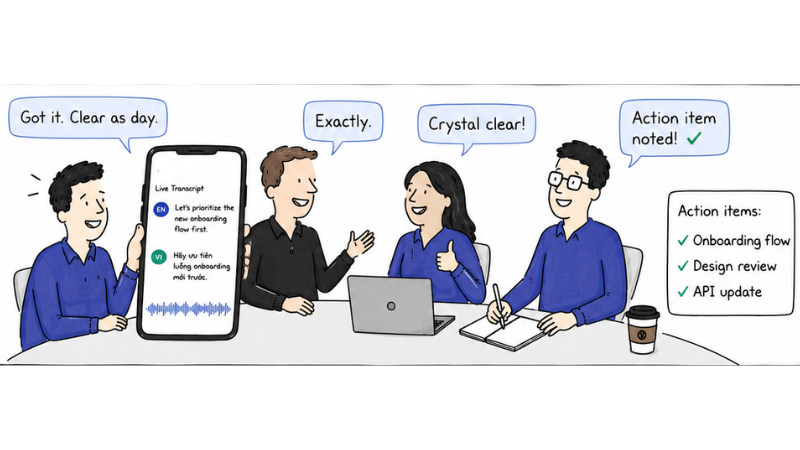
Every meeting is a knowledge asset. A good meeting summary is what turns the conversation into that asset.
A one-hour meeting with 10 people represents 10 person-hours of focused human attention. The output of that investment should not be a set of notes that 9 out of 10 people read once and forget. It should be a structured meeting summary that:
- Documents every decision with its context
- Attributes every action item to a named owner with a deadline
- Captures key discussion points in searchable, reusable form
- Exists in every language the team operates in
This is what meeting productivity actually means. Not shorter meetings or fewer meetings — meetings that generate a reliable, actionable meeting summary every single time.
Use AI meeting summaries, not manual notes
A full transcript of a one-hour meeting is not useful — it’s 8,000 words no one reads. AI meeting summaries extract what actually matters:
- Decisions — what was resolved and why
- Action items — who is doing what, by when
- Key discussion points — context that explains the decisions
- Commitments — what was promised and to whom
The transcript is the reference. The AI meeting summary is what people use and act on. This is the single highest-leverage improvement in meeting productivity most teams can make.
How Tengos Improves Meeting Productivity
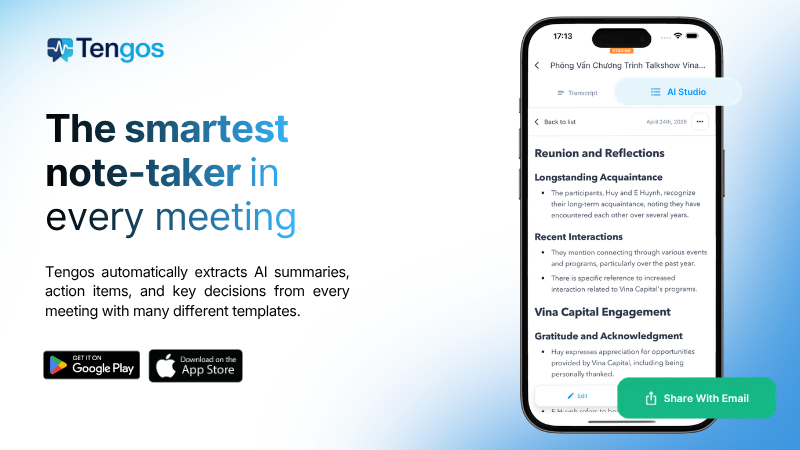
Tengos generates an AI meeting summary for every conversation in just 1 click. Real-time transcription across 100+ languages, structured meeting summaries with decisions and action items, shareable documentation ready before the call ends.
Every meeting becomes a structured knowledge asset with a reliable meeting summary
Start free at tengos.ai for your next meeting!
FAQs
1. How can teams improve meeting productivity with AI?
Replace manual note-taking with an AI meeting summary. Tengos transcribes every meeting in real time and generates a structured summary with decisions and action items — ready the moment the call ends, in 100+ languages.
2. Why does meeting productivity fail for most teams?
People forget 70% of what was said within 24 hours, and manual notes don’t solve it — they’re one person’s filtered perspective, arrive late, and miss nuance. The result: misunderstood decisions, lost action items, and re-meetings that should never happen.
3. What is the best AI summary tool to improve meeting productivity?
Look for a tool that combines real-time transcription, AI meeting summary generation, and action item tracking — with no login required for participants. Tengos does all of this automatically in 100+ languages with a single shareable link.
4. Does Tengos have different AI summary templates?
Yes. Tengos has purpose-built templates for team meetings, investor pitches, education and many other templates – each designed to extract the outputs that matter most for that context.